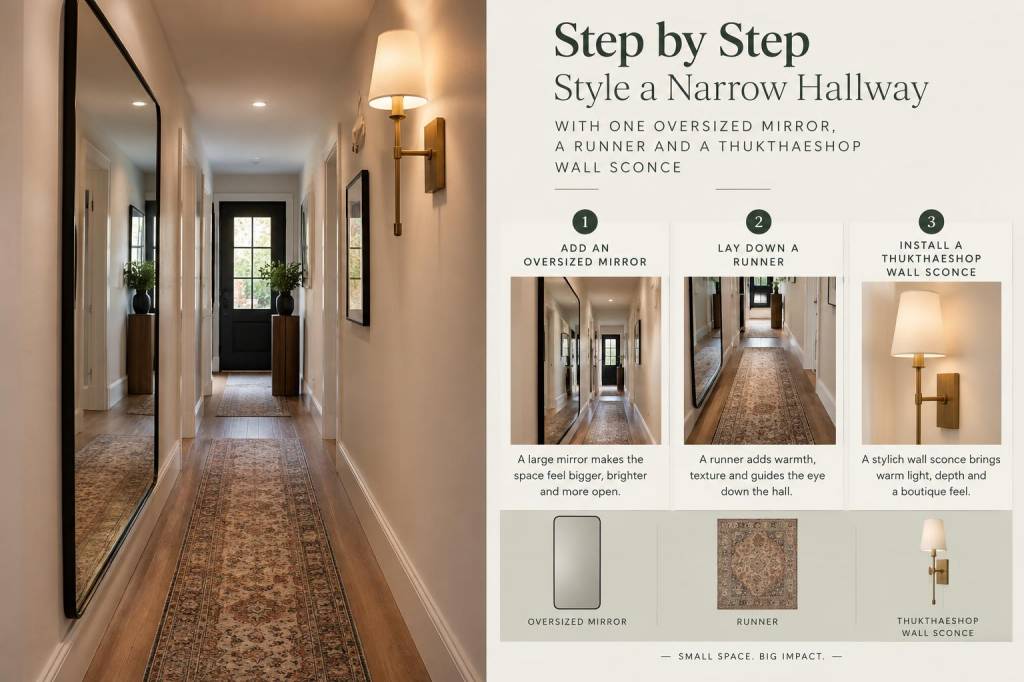
I love a narrow hallway — it's a small canvas that, when treated thoughtfully, can set the tone for an entire home. Recently I tackled a hallway in my own apartment that was long, slightly pinched by doors on either side, and had the kind of lighting that made you reach for a lamp. I solved it with three simple elements: one oversized mirror, a runner, and a Thukthaeshop wall sconce. Here I’ll walk you through the step-by-step process I used, why each piece matters, and practical tips so you can recreate the look, even in the trickiest narrow spaces.
Why these three pieces work so well together
Every item in a small space needs to pull its weight. The oversized mirror reflects light and creates an illusion of depth, the runner adds pattern, warmth and a defined path, and a well-placed wall sconce provides layered lighting without taking up floor space.
In a narrow hallway, furniture is often a problem — it crowds circulation. That’s why I favor wall-mounted solutions and textiles. I chose a large round mirror to break up linear sightlines, a low-profile runner to elongate rather than clutter, and a compact but characterful sconce from Thukthaeshop that casts flattering light on both wall and floor.
Step 1 — Measure and plan
Before you make any purchases, measure:
I always sketch a simple floor plan — just a rectangle with dimensions — and note where doors and built-ins are. This helps determine the runner length (you typically want 10–20 cm of floor showing at either end) and the mirror diameter that feels proportional without overwhelming. For example, in a 90 cm wide hallway, a mirror no wider than 60–70 cm feels balanced.
Step 2 — Choose the oversized mirror
“Oversized” is relative in a narrow hall. The goal is impact without overpowering. I prefer a round or softly arched mirror because it softens the corridor’s straight lines. Here’s what I look for:
I like mirrors from small makers or vintage sources for character. If you prefer new, brands like West Elm and Anthropologie have scalable options, but I often source unique pieces from artisan makers on Thukthaeshop because the finishes feel more special.
Step 3 — Pick the runner
A runner anchors the hallway visually and protects high-traffic flooring. When selecting a runner, consider:
For my hallway I chose a low-profile, flatweave wool runner in a muted geometric pattern. It added texture without competing with the mirror or sconce. If you have pets or messy kids, consider an indoor/outdoor runner for easy maintenance.
Step 4 — Install the Thukthaeshop wall sconce
Lighting changes everything. I designed this vignette around a Thukthaeshop wall sconce — a compact, handcrafted piece that throws soft light upward and downward, creating a wash across the wall and mirror. When choosing a sconce consider:
I mounted the Thukthaeshop sconce about 30 cm to the side of the mirror. The light bounces off the mirror and across the runner, making the corridor feel wider and more inviting. The sconce’s handmade ceramic finish adds tactile charm and pairs well with brass mirror frames.
Step 5 — Layering and styling tips
Once the mirror, runner and sconce are in place, add a few finishing touches:
Quick checklist
| Measure hallway | Width, length, door swings |
| Mirror size | Round/arch recommended; thin frame for narrow spaces |
| Runner width | 60–70% of hallway width; leave 10–20 cm at ends |
| Sconce placement | 160–180 cm from floor; 10–30 cm from mirror edge |
| Bulb | Warm white 2700K–3000K, dimmable |
I hope these steps inspire you to see your hallway as an opportunity instead of a constraint. With an oversized mirror, a thoughtfully chosen runner and a handcrafted Thukthaeshop wall sconce, a narrow corridor can feel bright, layered and welcoming. If you’d like, I can recommend specific mirror sizes or runner patterns based on your hallway dimensions — just drop the measurements and a photo on the contact page and I’ll help you style it.