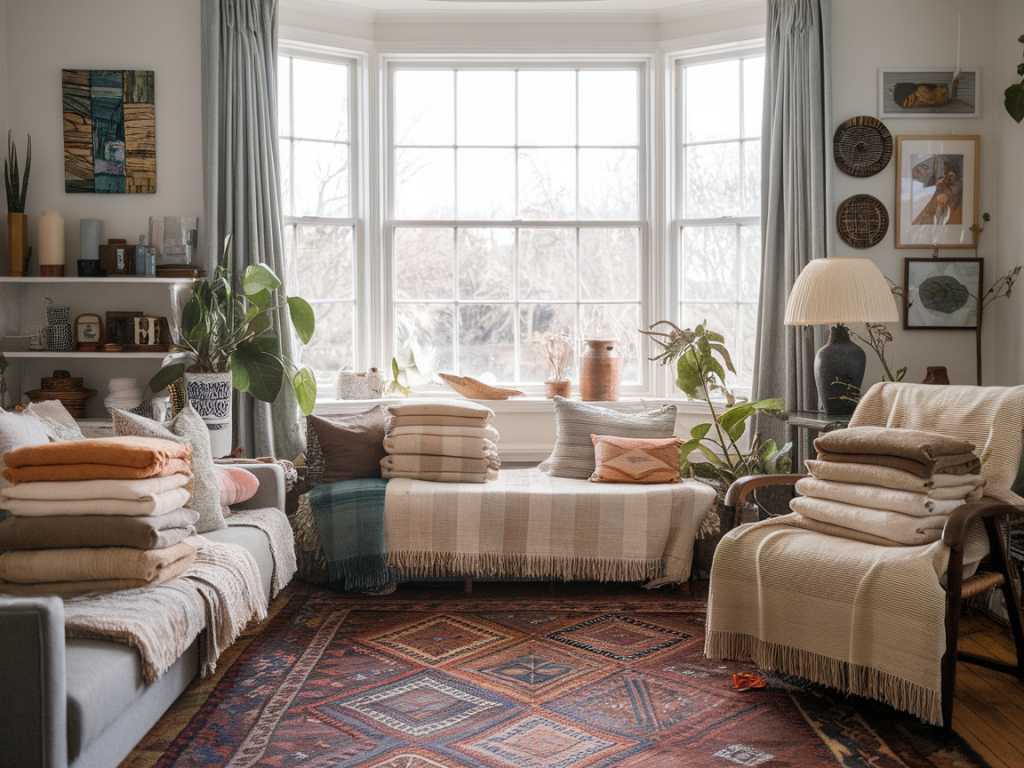
Living in a south-facing living room is a gift: light pours in all day, plants thrive, and rooms feel warm and uplifting. But that steady sun can also mean overheating in summer and sharp temperature swings between morning and night. Over the years I’ve learned that layering natural-fiber throws is one of the simplest and most beautiful ways to keep temperature comfortable year-round—without resorting to heavy drapes, constant thermostat adjustments, or bulky décor.
Why natural fibers?
Natural fibers behave differently than synthetics when it comes to heat and moisture. They breathe, regulate humidity, and adapt to body temperature. That means a linen throw feels cool when the room is hot; wool wraps up warmth in the evening without making you sweat. I always reach for natural fibers first because they’re comfortable, durable, and often look better with age.
| Fiber | Best for | Properties |
|---|---|---|
| Linen | Summer, humid heat | Highly breathable, cooling to the touch, lightweight |
| Cotton | All seasons, casual living | Soft, breathable, easy to launder |
| Wool (merino, Shetland) | Cool evenings, winter | Insulating, moisture-wicking, warm even when damp |
| Alpaca | Dry cold, luxurious warmth | Lightweight warmth, very soft |
| Silk | Temperature balancing, layered under other throws | Fine, insulating, breathable |
My layered system for a south-facing living room
I use three functional layers that I can add or remove as the day and seasons change. Each layer has a purpose—cooling, insulating, or comfort—so you can mix fibers depending on the weather and your personal comfort.
When the sun is high and strong, I remove the top layer and leave the linen base in place. As the sun shifts west and the room cools, I add the middle layer across my knees. After sundown, the top wool layer goes over my shoulders. It’s a simple choreography that keeps comfort consistent without clutter.
How to choose weights and sizes
Throw weight is commonly measured in GSM (grams per square meter) or described as light/medium/heavy. For a south-facing room where you want versatility, I recommend:
Pro tip: a larger, lighter linen looks effortlessly chic when casually draped and provides more sun protection for fabrics beneath.
Placement and styling that work with temperature control
How you place throws affects both their function and how quickly you can adapt to temperature changes.
Styling ideas that don’t sacrifice function: a linen throw casually knotted at one corner looks relaxed and stays put in breezy afternoons; a neatly folded wool across the arm reads intentional and is still easy to layer on when temperatures drop.
Seasonal swaps and color choices
I love using color and texture to reflect seasons while keeping practicality in mind. In summer I choose pale linen tones—washed white, sand, light grey—that reflect heat and feel cool. For autumn and winter, I introduce deeper hues—olive, rust, deep blue—and chunkier textures like brushed wool or alpaca for a sense of warmth.
Contrast textures rather than colors for subtle visual interest: pair a smooth linen with a nubby wool or a slubby cotton with a sleek silk throw underneath.
Care, durability and sustainability
Natural fibers require care to retain their performance. Here are practices I follow:
If sustainability matters to you (it does to me), look for responsibly sourced wool, organic cotton, or European-made linens. At Thukthaeshop I curate small-batch and handcrafted throws from makers who prioritize provenance and lower-impact production—pieces that feel better to live with because you can trace where they came from.
Extra tricks for a south-facing room
Small adjustments amplify the benefits of layered throws:
I find that the tactile pleasure of soft, natural textiles makes temperature management feel like self-care instead of an engineering problem. By selecting complementary fibers and keeping a simple layering system, you can enjoy a south-facing living room that’s bright and airy in the daytime yet cozy and inviting at night—without fussing with the thermostat every hour.
If you’d like, I can put together a curated bundle of throws for a south-facing space—linen for the base, a cotton-wool blend for transition, and a lightweight alpaca for evening warmth. You can also browse the Textiles section on Thukthaeshop for handpicked options that work together visually and functionally.