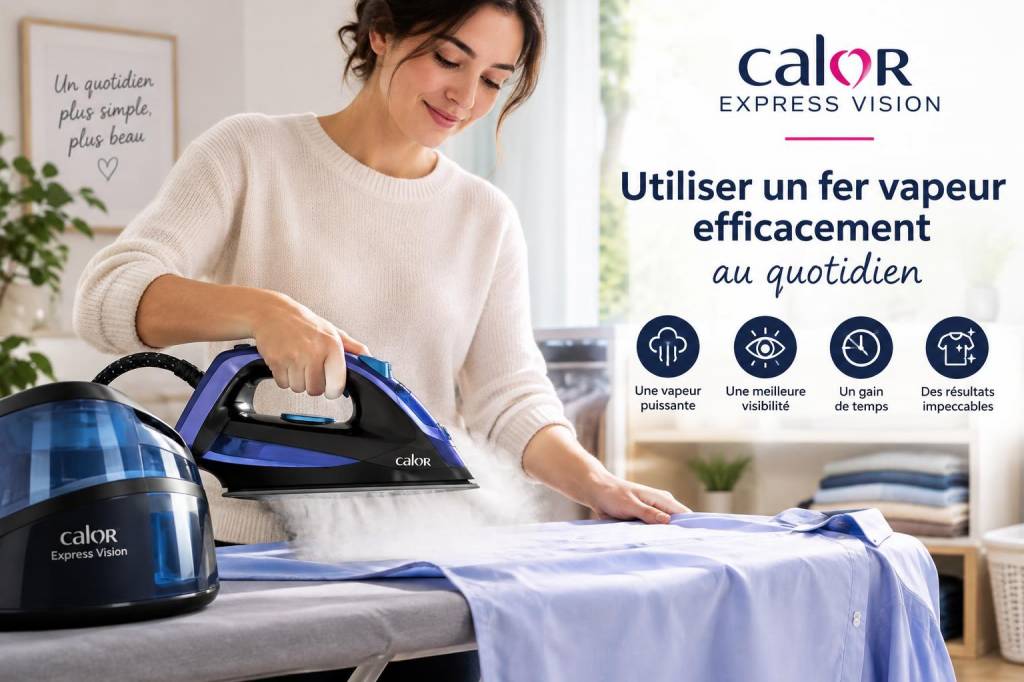
When I think about using a steam iron efficiently every day, I do not picture a rare laundry-day ritual. I picture a steady, low-stress habit that keeps shirts, duvet covers, curtains, and table linens looking cared for without wasting time, water, or energy. That is exactly why I like the Calor Express Vision approach: it is designed for people who want speed, strong steam, and a predictable result when life does not leave room for fuss. If you want a practical reference, I also like this resource on utiliser un fer vapeur efficacement au quotidien, which fits neatly into a daily routine centered on good textile care.
In a home where textiles matter, an iron is not just a tool for clothing. I use it to smooth pillowcases before a guest arrives, refresh a tablecloth after dinner, and make natural-fiber curtains hang beautifully again after washing. A steam iron becomes even more useful when it is easy to set up, fast to heat, and powerful enough to handle cotton, linen, viscose, and blended fabrics without repeated passes. That is the real promise I look for: less effort, cleaner results, and more confidence with every use.
Why daily steam ironing works better than occasional rushing
I have noticed that ironing becomes much easier when I treat it as maintenance rather than rescue work. A few minutes after drying, or a short session once a week, usually beats a long, exhausting session after a pile has grown too large. Fabrics crease less deeply when they are folded carefully, removed from the dryer promptly, and ironed before wrinkles set in.
There is also a practical side. Steam helps relax fibers, which means I often need fewer passes than with dry heat alone. On a modern steam iron, the combination of temperature and steam output can make the difference between a shirt that looks merely “less wrinkled” and one that looks truly finished. For me, that matters with bedding and home textiles, because smooth fabric changes the entire feel of a room.
- I save time by ironing smaller loads more often.
- I reduce stress because I avoid last-minute textile emergencies.
- I keep fabrics looking newer for longer by avoiding overworking them.
- I get more consistent results with natural fibers such as cotton and linen.
What I look for in a steam iron for everyday use
Not every steam iron suits a home-focused routine. For daily use, I look at a few features that matter more than marketing claims. Strong steam output is useful, but only if the iron stays comfortable to handle and responsive on different fabrics. A clear water tank, quick heat-up time, stable soleplate glide, and easy anti-calc maintenance are all important to me.
| Feature | Why it matters in daily use | My practical view |
|---|---|---|
| Steam output | Helps relax creases faster | I want enough force for cotton and linen without constant re-passing |
| Heat-up time | Reduces waiting and makes short sessions realistic | Fast readiness is essential when I only have ten minutes |
| Water tank visibility | Makes refilling easier | I prefer to see the level at a glance |
| Anti-calc system | Protects steam performance over time | This matters if I want consistent results month after month |
| Soleplate glide | Improves comfort and reduces snagging | I notice this most on duvet covers and table linens |
According to the European Commission’s energy-related product framework, efficient household appliances are increasingly designed with performance and resource use in mind, and that mindset makes sense for ironing too. I want a machine that delivers usable steam without excess waste. I also like to check manufacturer guidance and maintenance instructions, because a steam iron works much better when it is cared for properly.
My routine for using a steam iron efficiently every day
I follow a simple rhythm when I iron at home. I keep the board ready, sort fabrics in advance, and start with garments or linens that need the lowest heat before moving upward. This lets me work smoothly and avoids unnecessary cooling and reheating.
- I fill the tank with clean water, ideally filtered if my area has hard water.
- I let the iron reach temperature fully before I begin.
- I sort items by fabric weight and care label.
- I begin with delicate blends, then move to cotton and linen.
- I use steam in short bursts instead of holding the trigger continuously.
- I hang or fold each item immediately after ironing to keep creases away.
This routine sounds basic, but it works because it reduces friction at every stage. I do not waste time switching settings repeatedly, and I do not fight with fabrics that are not ready for heat. The result is calmer ironing and better-looking textiles throughout the house.
Fabrics I handle carefully and what they need from me
Different textiles respond very differently to steam, pressure, and heat. That is why I never treat every item the same way. A cotton shirt may welcome firm steam and direct contact, while a delicate curtain panel may only need a light pass from the reverse side.
- Cotton: I use medium to high heat with steady steam and a clean glide.
- Linen: I iron while slightly damp when possible, because that shortens the session.
- Viscose and blends: I work at lower heat and keep movement constant to avoid shine.
- Delicate synthetics: I use a protective cloth when needed and reduce direct pressure.
- Home textiles: I focus on wide, even strokes and let the steam do most of the work.
For household textiles, I find that results are often more visible than on clothing. A crisp pillowcase, a flat tablecloth, or a smooth curtain panel changes the atmosphere of a room in a way that feels quietly luxurious. That is one reason I care about ironing as part of home styling, not just wardrobe care.
Maintenance habits that protect performance over time
A steam iron performs well only if I keep it clean. I have learned that mineral buildup, leftover water, and blocked vents are the fastest way to lose steam quality. In practice, maintenance is simple, but it must be regular.
Here is what I do:
- I empty the tank after use whenever possible.
- I run the self-clean or anti-calc function according to the manual.
- I wipe the soleplate when it is cool, using a soft cloth.
- I avoid harsh abrasives that could damage the finish.
- I store the iron upright so residue and leaks do not become a problem.
These habits matter more than people think. Steam performance drops quickly when mineral deposits narrow internal channels. The U.S. Department of Energy also emphasizes that household energy use is shaped as much by habits as by equipment, and I think that applies beautifully here: a well-maintained appliance usually works better and lasts longer.
Practical numbers I keep in mind when planning an ironing session
I like simple numbers because they help me plan. A short weekly session of 15 to 20 minutes is often enough for a small household if laundry is managed steadily. For a larger pile of mixed textiles, 30 to 45 minutes feels more realistic. I also find that sorting items in advance can save several minutes per session, especially when I separate heavy cotton from delicate blends before I even turn the iron on.
In many homes, a steam iron can reach readiness in only a few minutes, which makes spontaneous use much easier. That is one reason I prefer appliances that heat quickly and maintain stable output. A machine that wastes five extra minutes every time feels less convenient over a month than it first appears.
I also pay attention to water habits. If the tank is designed for easy filling and the iron uses water efficiently, I am less likely to interrupt a session. That seems small, but it is exactly the kind of detail that determines whether a tool feels pleasant or annoying in everyday life.
Common mistakes I avoid when I want clean results
Over time, I have learned that most ironing frustration comes from a few repeated mistakes. Once I stopped making them, the process became much more predictable.
- I do not start before the iron is fully heated.
- I do not overload the board with too many items at once.
- I do not use too much steam on fabrics that only need a light pass.
- I do not ignore care labels, especially on blends and decorative textiles.
- I do not leave water inside the tank between uses.
I have also learned that speed is not the same as rushing. Efficient ironing comes from rhythm, preparation, and a sensible order of work. When I respect those three things, I get a much better finish with less effort.
Sources I trust when I want to verify appliance advice
I like to cross-check practical advice with external sources, especially when it touches energy, maintenance, or fabric care. These references help me stay grounded in reliable guidance:
- European Commission, energy-related products information: https://energy.ec.europa.eu
- U.S. Department of Energy, home energy use and appliance efficiency: https://www.energy.gov
- Consumer Reports, steam iron buying and care advice: https://www.consumerreports.org
When I combine those broader principles with everyday textile care, the process becomes much clearer: choose a responsive iron, maintain it well, and use it in a consistent way that matches my fabrics and routine.
FAQ
How often should I use a steam iron at home?
I prefer short, regular sessions rather than rare long sessions. Once or twice a week is often enough for a tidy household routine, especially if I handle laundry promptly.
Is steam better than dry heat for everyday ironing?
For most household textiles, I find steam more effective because it relaxes fibers and reduces repeated passes. Dry heat still has a place, but steam usually gives me a smoother finish with less effort.
Can I use one iron for both clothing and home textiles?
Yes, and I do. I simply adjust heat, steam, and pressure according to the fabric. That flexibility is one reason I value a strong all-purpose steam iron.
What helps a steam iron last longer?
Regular descaling, emptying the tank after use, and storing the iron properly all help maintain performance. I also avoid using rough cleaning tools on the soleplate.
What matters most when I want efficient everyday use?
For me, the main factors are heat-up speed, steam quality, comfort in the hand, and reliable maintenance features. When those align, the iron becomes easy to use and easy to trust.