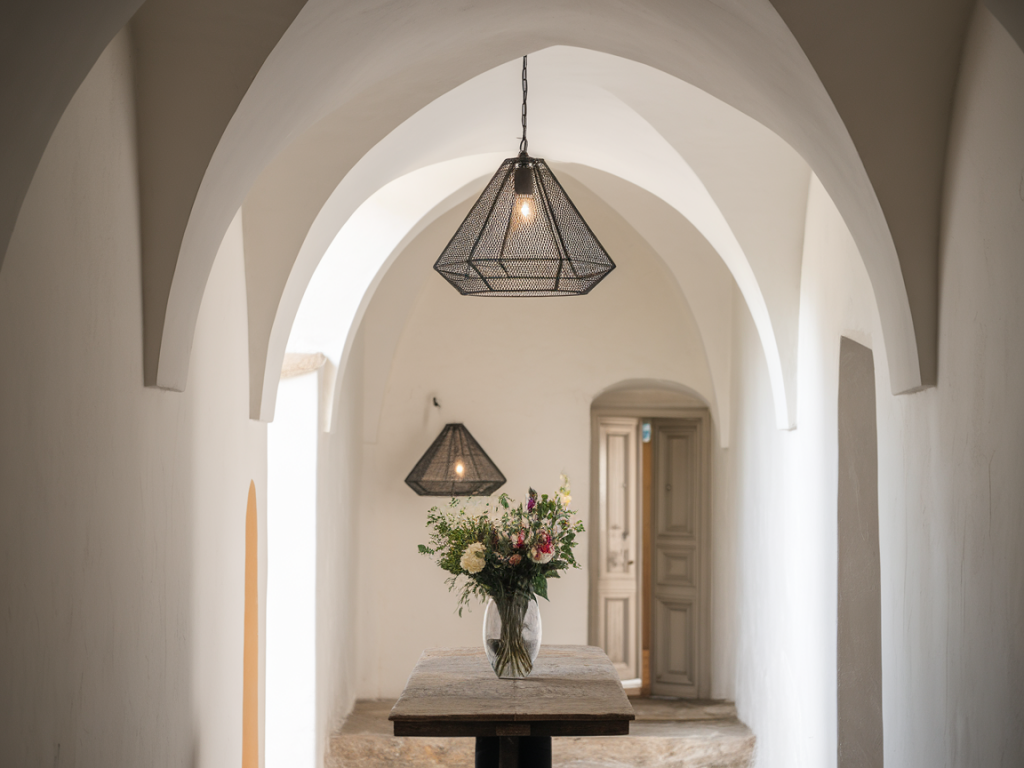
Vaulted hallways can feel both dramatic and challenging. I love the sense of height and movement they bring, but I also know how easy it is for that same vertical space to swallow light and make the passage feel cavernous rather than welcoming. Over the years, when I’m specifying lighting for vaulted entries or hallways, my goal is always the same: to make the ceiling feel purposeful, to pull the eye horizontally so the space reads more intimate, and—most importantly—to bring even, flattering light that makes the whole area feel brighter and larger.
What I look for in a pendant for a vaulted hallway
When choosing a pendant for a vaulted hallway I ask myself a few practical questions first:
Those answers determine scale, suspension type (rod vs chain), and the lamping strategy. Here are the attributes I find most effective for making vaulted hallways feel both brighter and more spacious.
Choose a fixture that emphasizes horizontal lines
Vaulted ceilings already push the eye up. To counterbalance that verticality and make the hallway feel wider, I often choose pendants with a strong horizontal emphasis. Linear suspension lights, multi-light bars, or elongated shades draw the gaze along the length of the corridor instead of straight up.
These shapes reduce the “cave” effect and guide sightlines along the hallway.
Opt for translucent or clear materials to maximize perceived space
Materials matter. Clear glass, open metal frames, or translucent shades feel lighter than dense, dark pendants. A glass globe or a lantern with open sides allows light to spill into the ceiling and walls, producing reflected light that visually expands the space.
I try to avoid heavy fabric or dark wooden pendants in narrow vaulted hallways unless I’m intentionally creating a moody, intimate vibe.
Scale: go slightly larger and stagger the height
Scale is the trickiest part. A too-small pendant disappears into a tall vault; too-large can feel oppressive. My rule of thumb: choose a pendant visually slightly larger than what you’d choose for a standard ceiling, but keep the profile open and airy. If the hallway is long, install a series of smaller pendants spaced evenly, or use two staggered fixtures at different heights to create depth and interest.
Prefer a rod suspension over chain for a cleaner line
Rod suspension systems read cleaner against angled ceilings. They give a precise, architectural look and align easily with the slope of a vault. Chain suspensions can feel fussy and visually heavy—unless you’re aiming for a relaxed, vintage look. For vaulted hallways where I want to emphasize neatness and horizontal flow, I usually spec fixtures with adjustable rods or a swaged canopy.
Light quality: color temperature and lumen guidance
Good light is more than brightness. For hallways I favor warm-white color temperatures in the 2700K–3000K range—this feels welcoming without being overly yellow. If the hallway opens into a modern kitchen or living room lit with cooler light, nudge toward 3000K for cohesion.
In terms of brightness, a hallway needs enough lumens to feel safe and airy but not so much that it glares. For a long vaulted hallway, aim for total output around 1500–3000 lumens distributed across fixtures. If you’re using multiple pendants or integrated LEDs, divide the target lumens across them rather than using a single very bright source.
Layer the lighting—don’t rely on a pendant alone
A pendant is rarely enough on its own for a vaulted hallway. I always combine it with:
Layering helps avoid stark contrasts and reduces deep shadows that make areas feel smaller.
Use dimming and smart controls
Dimming is essential. You want the flexibility to brighten the hallway when you’re arriving home with groceries, and to lower it for a soft evening glow. Smart controls also allow you to program different scenes—full lighting for cleaning, softer for late-night passage, or brighter for holiday displays.
My top pendant styles that work beautifully in vaulted hallways
Here are the pendant types I keep coming back to, with notes on why they work so well:
Practical examples I often specify
To make this more concrete, here are a few approaches I’ve used in client projects:
| Small urban townhouse, narrow vaulted hallway | Series of three 10–12” clear glass globe pendants on adjustable rods, staggered heights, paired with mid-height wall sconces. Result: feels airy, well-lit, with defined path. |
| Country home with dramatic vault | One long 48–60” linear LED pendant suspended low enough to read the space, supplemented with uplight grazing the ceiling. Result: horizontal emphasis and even ambient light. |
| Renovated cottage with angled pitch | Cluster of opal globes on a bar, dimmable warm-white LEDs, and mirror at the hallway end to multiply light. Result: cozy, bright, deceptively wide. |
Styling tips to amplify the effect
A few finishing moves make a big difference:
If you’re browsing for pendants, look for fixtures with adjustable drops and integrated dimming, and don’t be afraid to order samples or hang a temporary mock-up to test scale. A vaulted hallway is a beautiful opportunity to be intentional with lighting—choosing a pendant that emphasizes the horizontal plane, uses light-transmitting materials, and plays well with layers will always make the space feel both brighter and more spacious.