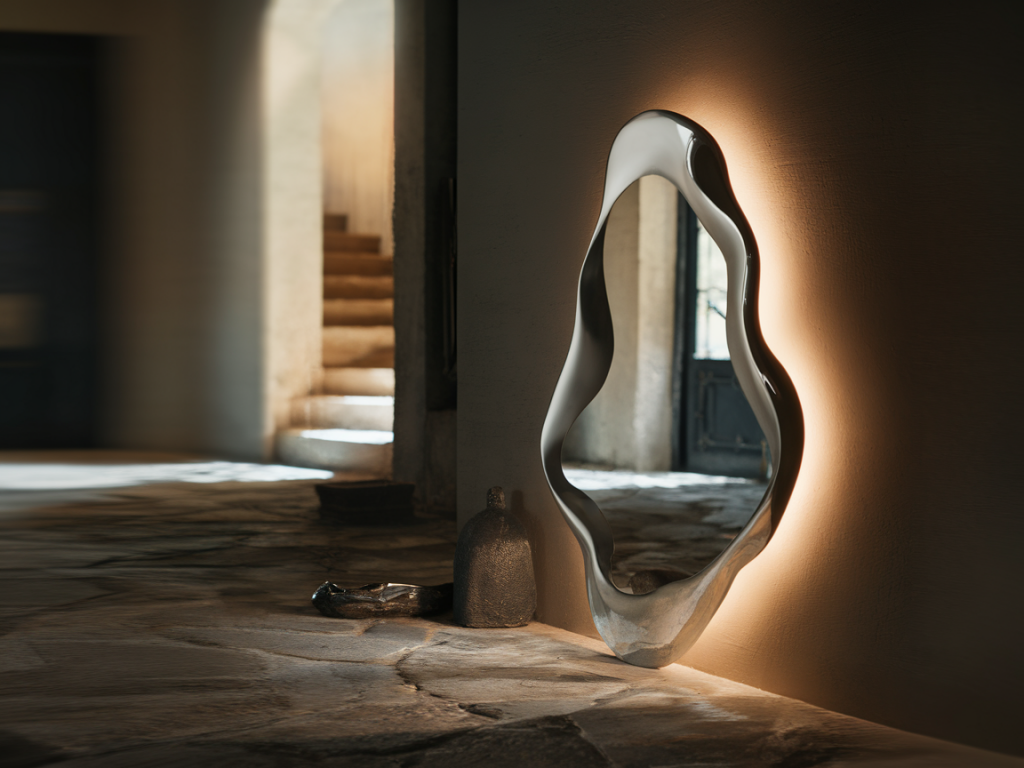
I often get asked whether a single sculptural wall mirror can truly pull double duty in a dark hallway — to act as a piece of art while also reflecting and amplifying light. From both my styling experience and countless small-batch sourcing trips, my answer is a wholehearted yes — but with a few practical caveats. A mirror can be far more than a functional object: chosen and placed thoughtfully, it becomes a focal artwork that changes the feel of a passageway and brightens it at the same time.
Why a sculptural mirror works as both art and a reflector
When I look for mirrors for Thukthaeshop, I’m not simply scouting for reflective surfaces; I’m scouting for personality. Sculptural mirrors often have irregular shapes, textured frames or even mixed materials (think hand-hammered brass, blown glass bezels or carved wood surrounds). Those defining visual characteristics let a mirror read as art even when the reflective surface is subdued.
At the same time, any clear reflective plane will bounce available light — natural or artificial — which is especially valuable in hallways where windows are sparse. The trick is choosing scale, finish and placement so the mirror reflects useful light rather than simply echoing a shadow.
How to choose the right sculptural mirror for a dark hallway
Size matters: A larger mirror will reflect more light and create a stronger sense of depth. In a narrow hallway, I aim for a mirror that’s at least 60–80% of the wall’s width when hung opposite a light source or in a position to catch ambient glow.Shape and frame: Organic or asymmetric shapes read clearly as art. But if the frame is very thick or heavily textured, make sure it doesn’t consume the reflective surface. I love mirrors with a delicate sculptural edge — enough visual interest to be an objet d’art, but with a sufficiently large reflective center.Finish of the glass: Classic clear glass reflects the most light. Antiqued or smoky finishes add atmosphere but reduce effective light return. If your priority is brightness, choose clear glass; if you want mood and patina, a lightly antiqued piece can still work.Material contrast: Combining tactile materials — a matte plaster surround, a rattan edge, a hand-beaten metal rim — helps the mirror read as a designed object instead of a utilitarian necessity.Mounting options: Consider slightly angling the mirror if you want to catch light from a specific source (for instance from a stairwell window or a pendant light). Many of the sculptural mirrors I select can be hung with a cleat that allows a tiny tilt safely.Placement strategies that actually brighten a hallway
Placement is everything. Here are approaches I use in real projects:
Opposite or adjacent to light sources: If there’s any natural light at the end of the corridor, hang the mirror opposite it to double the perceived window. If the only light is artificial, place the mirror near a sconce or pendant so the fixture’s glow is amplified.At eye-level for engagement: A sculptural mirror is both art and a practical piece. I usually hang it so the center sits roughly at 150–160cm (about 60–63 inches) from the floor — this works for most people and makes the object feel intentional.Grouped with art or alone as a focal point: In a narrow hall, a single statement mirror can act as an anchor. In wider spaces, consider pairing it with slim framed prints or a slim console table beneath it to create a vignette that reflects life — plants, vessels or a small lamp.Use reflective surfaces thoughtfully: If your hallway has other glossy finishes — lacquered doors or polished tiles — avoid over-reflecting by choosing a mirror with a softer edge or a partial frame to temper brightness.Lighting pairings that elevate both function and aesthetic
A mirror and light source are partners. Here are practical pairings I recommend:
Wall sconces flanking the mirror: When possible, add low-glare sconces on either side. They create balanced light that minimizes harsh shadows and lets the mirror shine as art without creating glare for passersby.Pendant light reflected from above: A sculptural pendant hung at the end of the hallway can be beautifully mirrored back, creating layered interest. Just make sure the pendant’s finish complements the mirror’s materials.LED strip behind the mirror: For a modern, museum-like effect, discreet backlighting (a thin LED strip behind the mirror) produces a soft halo that reads very much like an artwork and increases perceived brightness.Real-life examples from my edit at Thukthaeshop
I’ll often source mirrors that are as much about craft as they are about reflection. One example I love is a limited-run, hand-surfaced plaster mirror with an irregular organic rim — it reads like a small sculpture on the wall, and when placed opposite a skylight it throws a warm, diffused light back into the corridor. Another of my favorite pieces is a smoked-glass mirror with a hand-hammered brass trim: the brass adds texture and character, while the glass still manages to brighten a dim entrance when paired with a nearby pendant.
When I style these mirrors in client homes, I test them in-situ — I’ll tape a mockup or temporarily hang the piece to watch how it interacts with morning and evening light. That practical step prevents surprises and helps choose the right mirror finish and scale.
Common pitfalls to avoid
Too small for the space: A petite decorative mirror can feel lost and won’t significantly improve brightness. If the hallway is lacking light, err on the side of bigger.Highly antiqued mirror glass when brightness is the goal: Antiqued finishes are beautiful but lower the reflective output. If you want both mood and brightness, choose a partial antiquing or a mirror with a clear central field.Wrong placement relative to sightlines: Mirrors that simply reflect a wall or a closed door won’t add depth. Think about what the mirror will show and whether that reflected view contributes to brightness or interest.Styling tips to make it feel curated
Keep the surrounding pared-back: Let the mirror be the star in a narrow corridor — a slim console with a single vase or a stack of small books works well beneath it.Introduce texture below: A small runner with a tactile weave grounds the space and contrasts with the mirror’s surface.Choose complementary art: If you hang other pieces nearby, pick frames and tones that echo the mirror’s materials to create a cohesive curated look.If you’re curious about specific sculptural mirrors I stock at Thukthaeshop or want help selecting the right size and finish for your hallway, you can reach me via the contact page on https://www.thukthaeshop.com. I enjoy testing pieces in real spaces and helping clients achieve that balance between beautiful, functional lighting and artful expression.