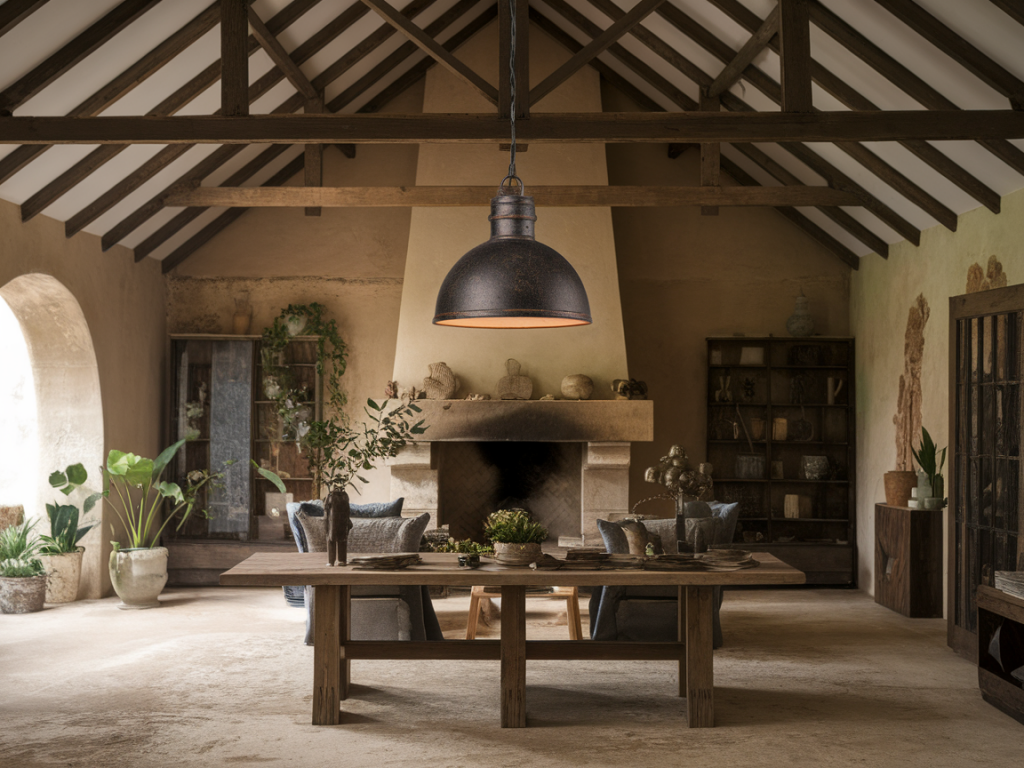
I love the drama of a vaulted ceiling and the sense of freedom an open-plan room brings. But I also know the challenge: how do you choose a pendant that feels proportionate, lights the space well and becomes an intentional part of the composition rather than an awkward afterthought? Over the years curating lighting for Thukthaeshop and testing pieces in real homes, I’ve learned a few simple rules and creative approaches that make selecting a pendant for high, open spaces both joyful and surprisingly straightforward. Here’s my practical, personal guide to help you pick a pendant that complements vaulted ceilings and open-plan layouts.
Read the room first: scale, sightlines and function
Before you fall in love with a beautiful fixture, take a moment to observe the space with fresh eyes. For vaulted ceilings and open plans I always start with three questions:
- What is the primary function of the area beneath the ceiling? (dining, seating, kitchen island, entry)
- Where will people naturally gather and where do sightlines lead? (you don’t want a pendant that blocks conversation or key views)
- How tall is the ceiling at the peak and at the areas where the pendant will hang? (measure — assumptions often mislead)
These answers drive your decisions about drop length, scale and whether you need a statement piece or a cluster of smaller pendants.
Choosing scale the simple way
Vaulted rooms can swallow small fixtures, so scale is everything. But oversized pendants can feel ominous if they dominate a cozy nook. I use a few easy rules of thumb:
- For dining or island zones: the pendant width should be roughly 1/2 to 2/3 the width of the table or island. For example, a 36" wide dining table pairs nicely with a pendant 18–24" across.
- For open-plan living areas: use fixtures that read well from multiple vantage points — either a taller vertical form that sits between sightlines, or a sculptural horizontal piece that aligns with furniture groupings.
- Consider multiple pendants: three smaller pendants over an island often feel balanced and provide flexible light compared to one giant fixture that can look visually heavy in an open plan.
Deciding drop height for vaulted ceilings
Drop height is the trickiest bit because vaulted ceilings vary so much. I rely on measured guidelines and then adjust for proportion and function:
- Over a dining table: leave about 30–36 inches from table surface to the bottom of the pendant for ceilings up to 9–10 ft. For vaulted ceilings, add roughly 3 inches for every additional foot of ceiling height — but stop when the pendant begins to feel distant. In very tall vaults you may prefer a cluster or a multi-tier fixture that visually anchors the table.
- Over an island: aim for 30–36 inches above the counter. If the ceiling soars, use adjustable rod or chain lengths and install a canopy that allows a lower, comfortable height rather than letting the pendant sit too high.
- In open-plan living areas without furniture anchor: pendants should either be high enough not to impede movement (7 ft minimum clearance) or deliberately low to create intimate zones (e.g., over a reading chair).
Use composition to anchor the eye
A vaulted ceiling lifts the eye — that’s a beautiful asset. But it also needs an anchor so the room reads as intentional. I often use one or more of these compositional strategies:
- Vertical anchors: tall pendants or multi-tier chandeliers that stretch downward help bridge the vertical void without feeling top-heavy.
- Horizontal anchors: long linear pendants over islands or a row of pendants can visually tie the ceiling to the furniture plane.
- Clustered pendants: groupings at different heights create a sculptural focal point and are especially effective in double-height entryways.
Layering light — beyond the pendant
One pendant rarely provides all the light you need in an open-plan or vaulted room. I always layer:
- Ambient light: recessed or track lights can wash the room and reduce harsh contrast.
- Task light: under-cabinet strips, table lamps or swing-arm sconces where you read or prep food.
- Accent light: picture lights or directional spots to highlight art or architectural features.
Combine warm LED sources and dimmers so the pendant can switch from dramatic to cosy with a click.
Materials and finishes that sing with volume
Materials behave differently in tall spaces. Matte finishes can recede, while reflective metals and glass catch and scatter light beautifully. My go-to choices:
- Hand-blown glass: creates softness and is excellent for clusters — think of the charm of blown glass pendants from small studios.
- Brass or aged metals: add warmth and a sense of history that complements high ceilings without shouting.
- Textured shades (rattan, woven paper): bring scale at a friendly price point and feel more intimate under expansive height.
Practical tips I use when sourcing pieces
- Ask for real-life photos from the seller of the fixture in a vaulted room — photos are worth a thousand measurements.
- Check the canopy size and wiring length — sometimes the supplied chain or cord is too short for a tall vault.
- Choose fixtures rated for dimmers and LED compatibility for best long-term performance.
- For rental or temporary spaces, consider a weighted pendant or floor-mounted pole pendants that don’t require rewiring.
Examples and pairings I've loved
To make this concrete, here are a few combinations that have worked well in clients’ homes and in my boutique styling:
- A row of three blown-glass pendants (each 8–10" diameter) over a 9-foot island in a vaulted kitchen — soft, even light and sculptural presence without overwhelming the ceiling.
- A two-tiered brass chandelier in a double-height entry — the verticality bridges the height and reads well from upstairs and below.
- A single oversized woven pendant over a tucked dining nook — texture and shadow make the nook feel intimate despite the open plan.
Quick reference table: pendant width vs. table/island size
| Table/Island Width | Pendant Width (approx.) |
|---|---|
| 36–48 in | 18–24 in |
| 60–72 in | 24–36 in or 2 smaller pendants |
| Over 72 in | 36–48 in or a linear fixture / 3 pendants |
Finally, don’t be afraid to experiment. I often install a temporary pendant or hang samples at varying heights before committing. Lighting transforms how a space feels by day and night, and in vaulted, open-plan rooms the right pendant will bring scale, focus and personality. If you’d like, I can share a shortlist of Thukthaeshop pendants that work for specific ceiling heights and zones — tell me your measurements and the look you’re after, and I’ll curate options that fit both the space and your style.