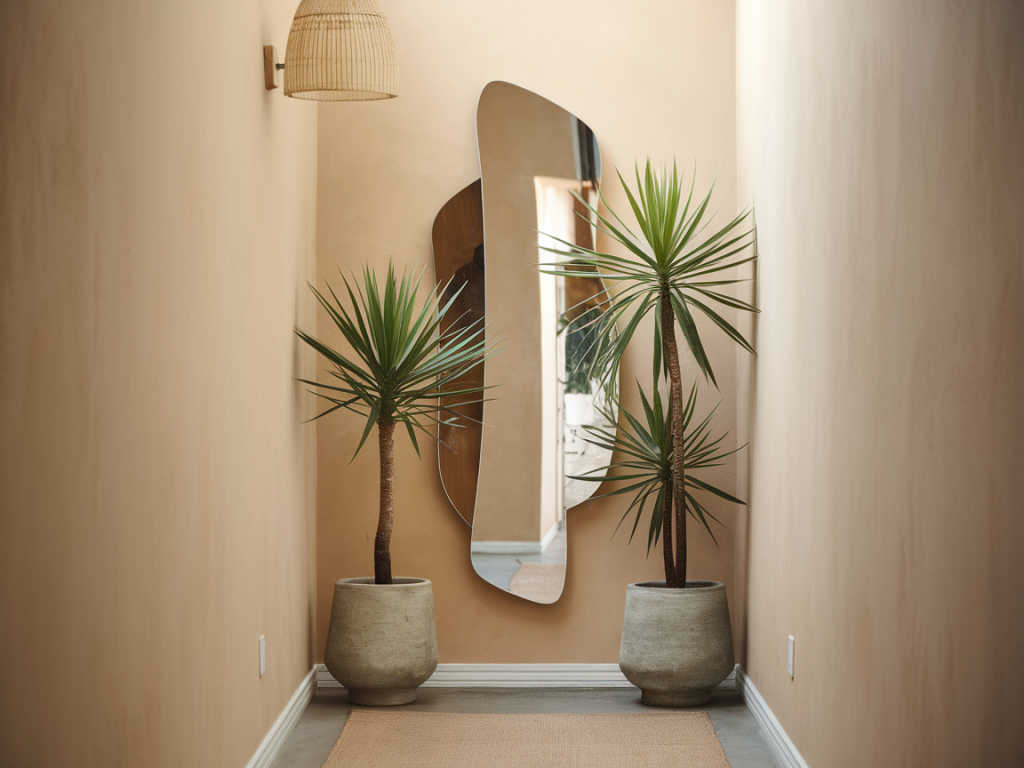
Can a single sculptural wall mirror from Thukthaeshop make a narrow hallway feel wider? I’ve tested this question in real homes, on mood boards, and in my own small entryway — and the short answer is yes, but with a few important caveats. A mirror can do much more than reflect: it can create the illusion of depth, introduce shape and texture, and act as a sculptural focal point that changes how you perceive a tight space.
Why a sculptural mirror works in a narrow hallway
People often ask me whether a mirror actually “adds space” or just tricks the eye. The truth is it does a bit of both. A mirror doesn’t physically expand your hallway, but it modifies visual cues that our brain uses to judge space. Here’s how:
Choosing the right sculptural mirror
Not every mirror will have the same impact. When I curate mirrors for Thukthaeshop, I look for pieces that combine strong silhouette with good reflective area and thoughtful materials. Consider these factors:
Where to place a sculptural mirror for maximum effect
Placement is everything. Here are my tested approaches that consistently make a hallway feel wider:
Styling with furniture and lighting
In a narrow hallway, less is more. Keep functional pieces slim and purposeful. Here are styling tips I follow when I style a hallway around a sculptural mirror:
Materials and makers I love
At Thukthaeshop I feature handcrafted mirrors that feel like art. Some pieces that work particularly well in narrow hallways:
If you’re after a signature look, I often suggest combining a sculptural mirror from an independent maker with vintage brass hooks or a small bench sourced from local craftsmen.
Practical considerations and FAQs
Below I answer the common questions I hear when customers consider a sculptural mirror for a hallway.
| Will a mirror make my hallway feel colder? | Not if you balance materials. Pair reflective surfaces with warm textiles (a wool runner), wood finishes or brass accents to preserve coziness. |
| What if my hallway is very narrow (less than 1m)? | Choose a flatter mirror with minimal projection and mount it higher so it doesn’t hinder movement. Consider a long, narrow mirror that mirrors the corridor’s proportions. |
| Is it better to use multiple mirrors or one statement piece? | A single statement sculptural mirror usually reads as calmer and more elegant. Multiple mirrors can work if they’re deliberately arranged to create rhythm rather than clutter. |
| How do I hang a heavy sculptural mirror safely? | Use proper wall anchors and, for very heavy pieces, a French cleat system. If in doubt, consult a professional fitter — safety first, always. |
Real-life examples and a few styling scenarios
I once styled a Parisian pied-à-terre where the hallway was a tight 90 cm. We mounted an oval, hand-forged iron-framed mirror about 1.2 m high opposite a doorway into the living room. The mirror reflected the living room’s tall arched window, and the corridor felt instantly less tunnel-like. A slim marble-top console under the mirror provided a landing spot for mail without crowding the passage.
In another home with a longer, darker corridor, I chose a round textured plaster mirror with integrated backlighting from a maker in Portugal. The mirror’s soft halo eliminated harsh shadows and the reflected light made the hallway feel twice as luminous as before.
If you’re considering a sculptural mirror from Thukthaeshop, think about the sightlines you want to enhance, the materials that suit your home’s temperature, and how the piece will interact with lighting. A well-chosen sculptural mirror doesn’t just make a narrow hallway look wider — it elevates the whole arrival experience, turning a passage into a moment of design.