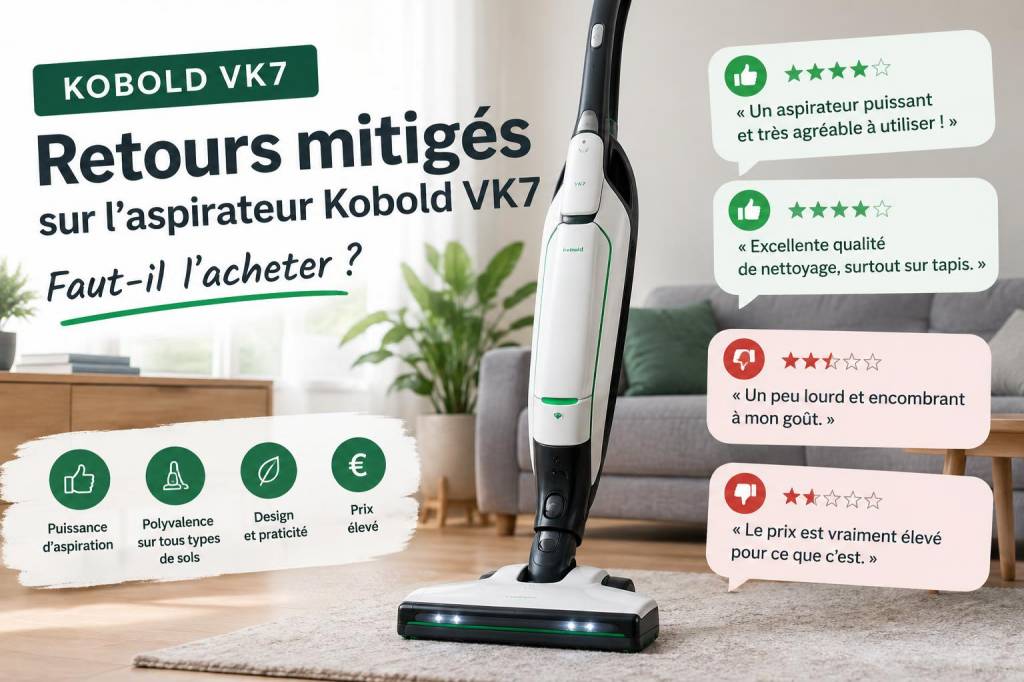
When I look at retours mitigés sur laspirateur Kobold VK7, I do not read it as a simple yes-or-no verdict. I read it as a signal that this vacuum divides opinion for very specific reasons: price, handling, accessories, and the way its strengths depend on the kind of home it enters. If you are exploring a purchase decision, I would suggest starting with a serious reading of this article here: retours mitigés sur laspirateur Kobold VK7. That context matters, because a premium cleaning tool can feel brilliant in one apartment and frustrating in another.
From my point of view, a mixed response usually appears when a product is technically solid but not universally convenient. That is exactly why I pay attention to user feedback rather than marketing promises alone. A vacuum can deliver strong suction, neat storage, and elegant engineering, yet still fail to satisfy if the maintenance routine feels heavy, if the battery rhythm does not suit a large home, or if the price creates expectations it cannot fully justify.
Why opinions split so clearly
What I notice first is that mixed reviews rarely come from one flaw only. They usually come from a combination of small frustrations. With a cordless premium vacuum like the Kobold VK7, buyers often expect a near-flawless everyday experience. When reality feels merely very good instead of exceptional, disappointment appears quickly.
I see five recurring sources of hesitation:
- Price positioning that feels high compared with rival cordless models
- Accessory bundles that vary depending on the offer or market
- Battery runtime that suits some homes better than others
- Head size and maneuverability that depend on furniture layout
- Maintenance and consumables that add long-term cost
That is why I never treat a vacuum as a single object. I treat it as a system: machine, battery, brush head, filters, bags or containers, and daily routine. If one part feels inconvenient, the entire experience can feel disappointing.
What stands out in real-world use
In reviews, I often find praise for suction consistency and the sense of engineered precision. Users like when a vacuum feels sturdy, balanced, and designed for frequent use. I also see appreciation for a cleaner floor result in homes with mixed surfaces, especially when hard floors and rugs coexist.
At the same time, criticism tends to appear when expectations are shaped by its premium image. Some buyers want a lightweight, “grab-and-go” tool for fast cleaning sessions. Others want a machine that can handle a whole house in one uninterrupted pass. If either expectation is too strong, mixed feelings appear quickly.
In practical terms, I would summarize the feedback this way:
| Aspect | Frequent positive reaction | Frequent negative reaction |
|---|---|---|
| Suction | Strong and stable on daily messes | Not always enough to justify the premium for some users |
| Handling | Well-built and refined | Can feel less effortless in tight spaces |
| Battery | Good for routine cleaning sessions | Too limited for large surfaces or deep cleans |
| Maintenance | Clean design and structured storage | Recurring cost and upkeep can feel demanding |
| Value | Premium feel and serious performance | Price-to-benefit ratio may not satisfy every household |
What I would check before buying
If I were evaluating the VK7 for my own home, I would focus on a few concrete questions rather than on brand reputation alone. These questions are more useful than broad praise or broad criticism.
- How large is the living space I need to clean on one charge?
- Do I use mostly hard floors, carpets, or a mix of both?
- Do I prefer quick daily cleaning or longer weekly sessions?
- Am I comfortable with replacement bags, filters, or brand-specific accessories?
- Do I value premium design enough to accept a higher entry price?
If your answer to most of these questions is yes, the Kobold VK7 may fit you well. If several answers are uncertain, I would slow down and compare alternatives carefully. A premium vacuum should simplify life, not create hidden irritation.
Who seems most satisfied
From the feedback I have studied, the most satisfied users are often those living in medium-sized homes or apartments, especially when their cleaning habits are frequent and relatively short. They value a vacuum that is ready often, easy to store, and pleasant to handle. They also tend to appreciate a more structured system, where accessories and maintenance follow a clear routine.
I also see strong approval from people who dislike cheap-feeling plastic appliances and want something that appears more refined in a visible storage area. In a home-focused environment, appearance matters. If a vacuum is stored in a utility area, that may be irrelevant. If it remains visible in a living space, design becomes part of the purchase.
Who seems least satisfied
The most critical reviews often come from users with larger homes, heavy cleaning needs, or higher sensitivity to price. They may feel that the machine asks for too much money upfront and too much attention over time. Some also compare it with other premium cordless vacuums and conclude that the VK7 is excellent, but not exceptional enough to dominate its price bracket.
I also notice frustration from people who expected a universal solution. No vacuum is perfect for every surface, every household rhythm, and every storage habit. Once that expectation collapses, the review can become harsh very quickly.
Useful numbers and market context
When I weigh a purchase like this, I like to look at public market data rather than only user comments. According to Statista, the global vacuum cleaner market continues to grow steadily, driven by cordless adoption and convenience-focused households. In parallel, many category reports show that cordless models are gaining share because they fit fast cleaning routines.
From major retail listings and brand documentation, premium cordless vacuums often sit in a price zone that can feel above average for buyers who compare them with mass-market alternatives. That matters because even a small performance advantage may not feel sufficient if the purchase price is significantly higher. In practical terms, I would expect price sensitivity to remain one of the main reasons for mixed opinions.
I also pay attention to independent testing patterns. Consumer-focused publications consistently stress the importance of runtime, suction on debris of different sizes, and ease of emptying or maintaining the machine. Those are not glamorous factors, but they shape daily satisfaction more than any spec sheet headline.
What sources I trust for a balanced view
When I want a more grounded decision, I combine official product information with independent review sources. A few useful references include:
I do not use these sources to chase a perfect score. I use them to identify patterns. If multiple independent sources mention runtime limits, handling trade-offs, or value concerns, I take that seriously. If official material highlights premium engineering while users complain about ownership cost, I treat that gap as meaningful.
My buying logic for a home-focused decision
For a home and décor audience, a vacuum is not only a cleaning tool. It is part of the atmosphere of the house: a device that either supports a calm, orderly interior routine or interrupts it. That is why I think the VK7 deserves attention from buyers who want a polished, design-conscious appliance and who clean often enough to justify it.
If I were advising a reader directly, I would say this: focus less on the idea of “excellent vacuum” and more on the fit with your home rhythm. A beautiful object that does not suit your routine will still disappoint. A technically strong appliance that fits your needs will feel worth it even if the review landscape is mixed.
FAQ about the Kobold VK7
Is the Kobold VK7 worth it for a small home?
It can be, especially if you value premium build quality and frequent short cleaning sessions. Small homes often benefit more from cordless convenience than large homes do.
Why do some people leave negative reviews?
Most criticism seems to come from price expectations, battery limits, and a mismatch between the product and the buyer’s cleaning habits.
Is maintenance a major concern?
It can be. Any premium vacuum with accessories, filters, or bags creates ongoing cost and routine attention. That is not a flaw by itself, but it is important.
Should I compare it with cheaper cordless vacuums?
Yes. That comparison is essential if value matters to you. A premium price only makes sense when the extra comfort or performance is useful in your own home.