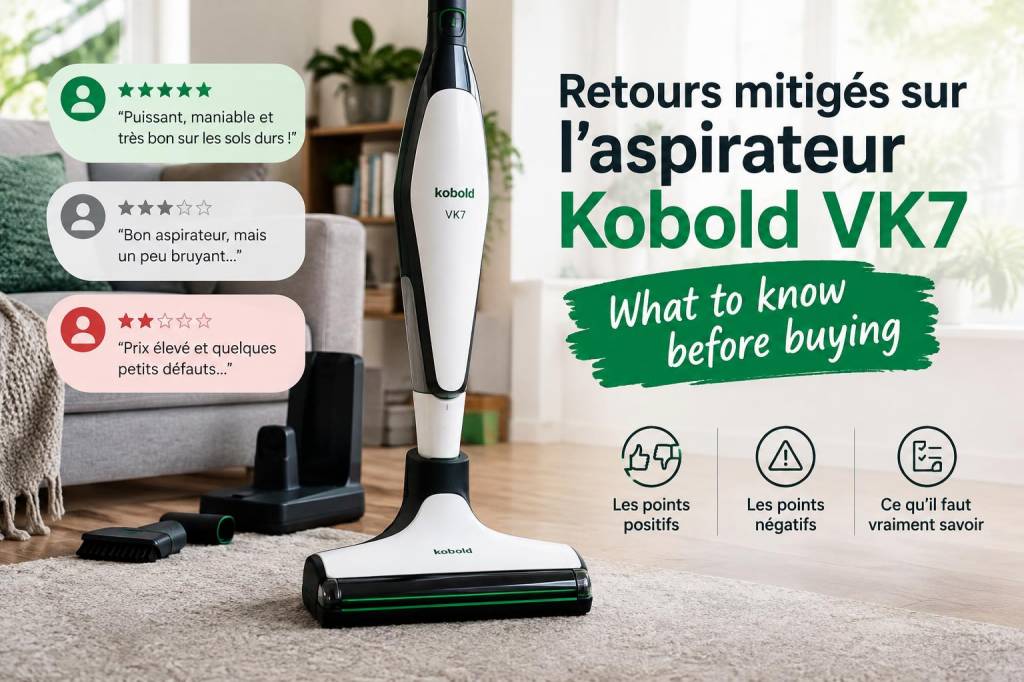
I have spent enough time around home appliances to know that mixed feedback is rarely random. It usually points to a product that does several things very well, while still leaving some buyers disappointed on a few specific points. That is exactly why I wanted to look closely at retours mitigés sur laspirateur Kobold VK7 before treating it as a serious purchase for a modern home.
For a home-focused site like Thukthaeshop, this matters because a vacuum cleaner is not just a technical object. It changes how a room feels, how often I clean, and even whether a space still feels calm after everyday use. A cordless vacuum with strong performance can become part of a home rhythm; a disappointing one becomes clutter with a battery. So I prefer to read mixed opinions as useful signals rather than noise.
Why mixed feedback matters more than star ratings
When I compare appliances, I rarely stop at the average score. A product can sit near 4 stars and still frustrate a specific type of household. With the Kobold VK7, the mixed feedback seems to revolve around a familiar pattern: some users love the handling, modular design, and cleaning power, while others feel underwhelmed by price, accessory costs, or everyday convenience.
I find this especially important because vacuum cleaners are intensely practical purchases. A lamp can be beautiful and still be a “yes” purchase. A vacuum has to earn its place through daily use. If a buyer expects effortless maintenance, a long runtime, and a premium finish all at once, small compromises become much more visible.
What I look for in mixed reviews is not whether people adore or dislike the product, but why. In the case of the Kobold VK7, the criticisms tend to cluster around a few recurring themes:
- Price positioned at the premium end of the market
- Accessory ecosystem that can increase total cost
- Weight and handling preferences that vary by user
- Noise expectations versus real-world use
- Battery runtime that may feel shorter in higher-power modes
What the Kobold VK7 seems to do well
I never want to ignore the positive side when examining negative or mixed opinions, because balance is what makes a review useful. The VK7 is often appreciated for its strong suction, thoughtful engineering, and floor-care versatility. For homes with mixed flooring, this kind of machine can be attractive because it is designed to move between hard floors and carpets without feeling like a bulky canister vacuum from another era.
One strength I often see highlighted in reviews of premium cordless cleaners is maneuverability. A vacuum that feels agile around chairs, sofas, and table legs can make a real difference in daily life. For a styled home, where furniture placement and decor matter, I care about devices that do not feel aggressive in the room. A cleaner should support the space, not dominate it.
Another point in its favor is brand trust. Vorwerk has a long-standing reputation in the home appliance category, and that matters because buyers often accept a higher initial price when they believe engineering and after-sales support will be solid. According to Vorwerk’s own product information, the VK7 is positioned as a premium cordless system, which already tells me that expectations should be set accordingly.
Where disappointment usually comes from
The most common source of frustration is value perception. A vacuum can be technically excellent and still leave buyers feeling that the complete package is too expensive. That feeling becomes stronger when useful accessories are sold separately or when buyers realize that “starting price” and “fully equipped price” are very different numbers.
I also notice that premium products often split opinion on ergonomics. One user may find the machine balanced and easy to steer; another may feel it is heavier than expected after ten minutes of use. That difference is not a contradiction. It simply reflects body size, cleaning habits, flooring type, and even household layout.
Battery performance is another area where expectations can drift. A cordless cleaner is convenient, but convenience depends on how much runtime you truly need. If I clean quickly once a day, a moderate runtime may be enough. If I do a deep clean of multiple rooms, stairs, and rugs in one session, I will care much more about charging cycles and power modes.
Some buyers also expect a quieter experience from a premium machine. In practice, strong suction often brings noticeable sound. This is not a defect so much as a tradeoff, but it can still shape buyer satisfaction. I would rather know this beforehand than discover it during a Saturday morning clean-up.
What numbers and sources can actually tell me
When I evaluate a product like this, I prefer to anchor opinions in external references. Vorwerk’s official site provides the basic product positioning and feature claims. Consumer testing organizations, retailer listings, and owner reviews add a second layer by showing what happens after purchase. For example, consumer review platforms often reveal recurring comments about runtime, accessory choices, and long-term comfort.
Three types of external sources are especially useful to me:
- Manufacturer data for battery, configuration, and design claims
- Independent consumer tests for performance and usability comparisons
- Owner feedback for day-to-day friction that test labs may not capture
From a practical perspective, I always pay attention to numbers that affect ownership cost and daily convenience. A cordless vacuum may advertise premium suction, but I want to know the runtime in real use, the charging time, the dust bin capacity, and whether replacement parts are easy to source. A feature list without these numbers is just marketing.
As a general benchmark, many cordless vacuums in the premium segment compete in a range of roughly 20 to 60 minutes of usable runtime depending on power mode. That wide spread matters because a “short” runtime may be perfectly acceptable for apartment living and frustrating in a larger house. Likewise, premium cordless vacuums often sit in a price band that can move from several hundred euros into four figures once accessories and extra batteries are added. That is exactly where buyer regret can begin if the purchase feels fragmented.
Comparison table: what buyers seem to weigh most
| Purchase factor | What buyers like | What buyers question |
|---|---|---|
| Suction power | Strong everyday pickup on floors and rugs | Does higher mode drain battery too quickly? |
| Handling | Agile, modern, easy to move around furniture | Can feel less comfortable for long cleaning sessions |
| Price | Premium build and brand reputation | Total cost may rise with accessories |
| Battery | Convenient cordless use | Runtime may depend heavily on selected mode |
| Maintenance | Modern system, easy routine use | Replacement parts and consumables add cost |
Who may enjoy it, and who should hesitate
If I were advising a friend, I would say the VK7 seems most suitable for someone who values premium engineering, already prefers cordless cleaning, and is comfortable paying more for a polished experience. It may also appeal to households that want a cleaner with a strong brand story and a refined feel.
I would hesitate if the buyer is extremely price sensitive, has a very large home, or wants maximum runtime without thinking about charging cycles. I would also hesitate if the buyer expects all useful attachments to be included from day one. In other words, it is not just a question of whether the machine works; it is a question of whether the ownership model matches the household.
Here is the short checklist I would use before buying:
- Measure the size of the home and estimate cleaning time per session
- Check whether accessories needed for stairs, upholstery, or tight corners are included
- Compare the total package price, not only the base unit
- Read owner reviews from people with similar flooring and room size
- Confirm battery expectations in normal and boosted modes
What I would verify before spending premium money
I always ask myself whether a premium appliance solves a real problem or simply adds status. For the VK7, the useful question is not “Is it good?” but “Is it good for my home?” A compact apartment with mostly hard floors will stress a vacuum differently from a family home with pets, rugs, and multiple levels.
I would also verify after-sales details. Premium appliances should come with clear support, easy-to-understand spare parts access, and a warranty that feels meaningful rather than decorative. The peace of mind of ownership matters almost as much as suction.
Another thing I personally value is repairability. A well-designed home appliance should not become disposable after a small failure. If I am paying a premium, I want a product that can be maintained rather than replaced at the first inconvenience.
What the mixed opinions really signal
When I step back, the mixed opinions around the Kobold VK7 do not read like a simple warning label. They read like a reminder that premium cleaning systems can be impressive and imperfect at the same time. That is not unusual. In fact, it is often what happens when a brand pushes for high performance and modular flexibility.
For me, the most useful insight is this: the VK7 appears to attract buyers who appreciate engineering, but some of those same buyers later question whether the total cost and everyday convenience fully justify the investment. That tension is the heart of the mixed feedback. It does not make the vacuum irrelevant; it makes the buying decision more personal.
Sources I would consult before purchase include Vorwerk’s official product pages, independent consumer testing organizations such as Stiftung Warentest when available, major retailer listings with verified owner reviews, and detailed comparison sites that explain battery, weight, and accessory differences in plain language.