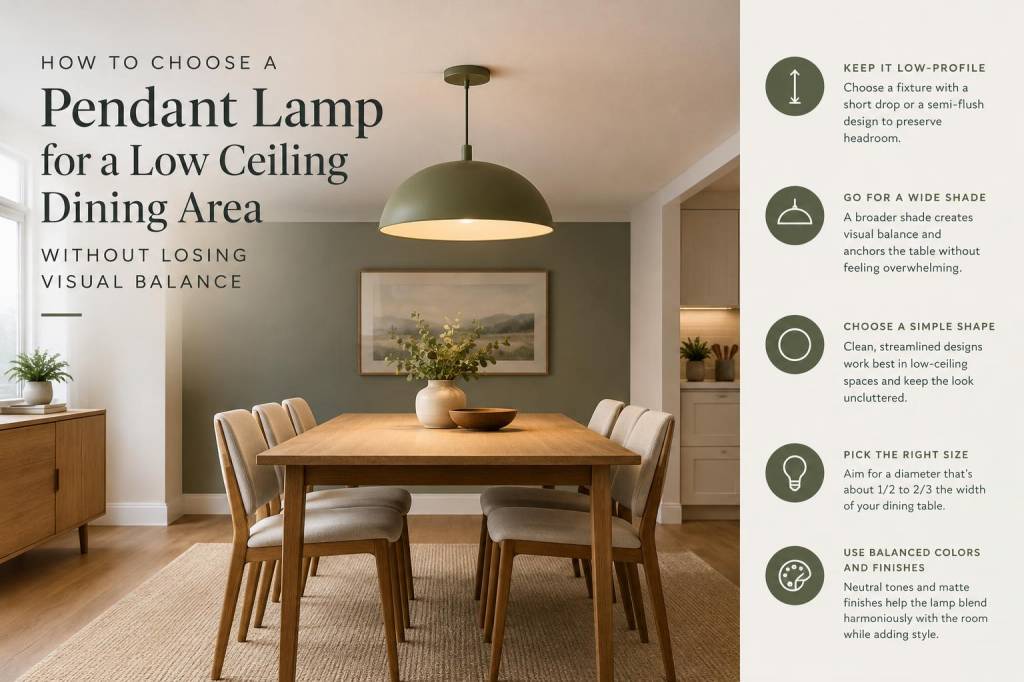
Choosing a pendant lamp for a low-ceiling dining area has always felt like a small design puzzle to me: I want atmosphere, but I do not want the room to feel crowded. I want a statement, but not a visual obstacle. In a space with a lower ceiling, every choice matters a little more, because height, scale, and light distribution all work together. When I am helping shape a dining area, I start by asking a simple question: what do I want this room to feel like when the lamp is off, and what do I want it to do when it is on?
That question keeps me from choosing a pendant only because it looks beautiful in a showroom image. A lamp can be sculptural and still be practical. It can feel warm and refined without hanging too low. In a dining area with limited overhead height, I pay close attention to proportions, the distance above the table, the spread of light, and the visual weight of the fixture itself. Those details decide whether the room feels calm and balanced or cramped and overly busy.
Start with the room, not only with the lamp
When I am selecting a pendant for a low ceiling, I first look at the full dining setup. I consider the table shape, the room width, the number of seats, nearby furniture, and whether the dining area opens into another living space. A compact room with a round table usually welcomes a different kind of pendant than a long rectangular table in an open-plan interior. I also think about the surrounding finishes: a pale ceiling, dark flooring, textured walls, or a visible beam can all change how tall or low a pendant appears.
One mistake I often see is choosing a fixture in isolation. A lamp may be technically “small,” yet still feel heavy if it has a dense shade, a dark finish, or a strong silhouette. For a low ceiling, I prefer a pendant that feels airy in its profile, even if it has presence. Glass, openwork metal, slim linen shades, and softly curved forms often work especially well because they bring character without dominating the room.
Mind the hanging height
The hanging height is usually the first practical decision I make. Over a dining table, I like the bottom of the pendant to sit low enough to create intimacy, but high enough that sightlines remain open. In many spaces, that means positioning the fixture roughly 30 to 36 inches above the tabletop, though I always adjust depending on the scale of the lamp and the people using the room. If someone is tall, or if the table is used for work and family meals, I lean toward a slightly higher placement.
With a low ceiling, I avoid anything that drops too dramatically. I am careful with long chains, oversized stems, and layered multi-drop arrangements unless the room is very forgiving. A pendant should frame the table, not interfere with conversation or movement. I like to stand at the table and imagine someone reaching for a dish, leaning in to talk, or simply looking across the room. If the fixture seems intrusive in that mental picture, I know it needs to be higher or slimmer.
Choose a shape that supports visual balance
The shape of the pendant matters almost as much as the size. In a low-ceiling dining area, I often reach for flatter or more compressed silhouettes because they keep the vertical line under control. A dome can work beautifully if it is not too deep. A shallow bowl, a low-profile disc, or a wide linen shade can offer a soft focal point without creating a heavy downward pull.
I also like pendants with a slightly wider footprint when the ceiling is low. A broader shape can feel more grounded and intentional than a narrow fixture that hangs too far down. This is especially true above a rectangular table, where a pendant with horizontal emphasis often echoes the table’s proportions and creates calm symmetry.
On the other hand, if the dining area is small and the table is compact, I may choose a lighter visual form: a slim opal glass globe, a perforated metal shade, or a simple woven piece with open texture. These options add interest while keeping the upper part of the room feeling open.
Let material do part of the work
Material changes everything. I have learned that a pendant does not need to be physically tiny to feel unobtrusive. Some materials visually recede, while others demand attention immediately. Glass is one of my favorite choices for low ceilings because it lets light travel through the space and does not interrupt the view as much as a solid shade. Clear glass feels almost weightless, while opal glass softens the light and still keeps the silhouette understated.
Natural materials can also be excellent, especially when they are finely made. A paper shade, a linen drum, or a handwoven piece can bring softness without visual heaviness. I am careful with very dark finishes in low-ceiling rooms, unless I want a deliberate contrast and the rest of the room is quiet. Matte black, aged brass, and smoked glass can all work, but I use them with restraint so the fixture does not overpower the ceiling line.
I often think of material as a way to tune the lamp’s personality. If I want warmth, I choose texture. If I want lightness, I choose translucence. If I want structure, I choose a cleaner geometry. The right material can make a pendant feel perfectly suited to a lower room, even when the design is quite distinctive.
Pay attention to the table size and lamp diameter
Scale is where many people feel uncertain, and I understand why. A pendant that looks elegant in a large showroom can seem too small above a generous dining table, while a fixture that feels lovely in a product photo can overwhelm a compact space. My own habit is to measure the table first and use that as a starting point. A pendant should usually be proportionate to the tabletop, not to the entire room alone.
For a round table, I like a pendant that feels centered and contained. For a rectangular table, I may choose one larger pendant placed along the center axis, or I may use a linear fixture with a low profile if the ceiling allows. In a low-ceiling room, I am careful with very tall lantern shapes, because they can pull too much attention downward. A wider, shallower lamp often creates a more elegant result.
| Dining setup | Pendant direction | Visual effect |
| Small round table | Compact globe, shallow dome, or glass shade | Light, centered, easy to live with |
| Rectangular table | Wide shallow pendant or slim linear fixture | Balanced, structured, connected to table shape |
| Open-plan dining zone | Airtight silhouette with visual simplicity | Defined without interrupting the broader room |
| Very low ceiling | Flat profile, translucent material, short drop | Open ceiling line, less visual pressure |
Use light quality to make the room feel larger
In a low-ceiling dining area, I care deeply about light quality. A pendant should not only look good; it should make the room feel more generous. I prefer lamps that cast a soft, even glow rather than harsh direct brightness. Diffused light can lift the mood of the whole space, especially in the evening, when the ceiling can otherwise feel lower and more compressed.
If the pendant has an exposed bulb, I make sure the bulb itself is pleasant to look at and not too bright. Warm color temperature helps enormously. I want the dining table to feel inviting, and I want the ceiling to disappear a little into the background rather than become a hard visual boundary. Dimmer compatibility is a major advantage, because it lets me adapt the room for everyday meals, candlelit dinners, or longer evenings with guests.
I also like to think about the shadow pattern. Some pendants create beautiful halos, while others project a crisp glow downward. In a low-ceiling room, soft diffusion is often more forgiving. It reduces glare and helps the lamp feel integrated instead of imposed.
Keep the ceiling line as calm as possible
One of my favorite strategies is to reduce visual clutter around the pendant itself. If the ceiling has too many competing details, the room can start to feel busier than it really is. I prefer a neat canopy, a clean mounting point, and a fixture that looks intentional rather than fussy. When the ceiling is low, simplicity often reads as elegance.
If there are beams, ducts, or architectural interruptions, I try to work with them rather than against them. Sometimes a pendant that aligns with a beam or a table edge feels more settled. Sometimes a fixture in a finish that echoes another detail in the room creates the harmony I want. I am always looking for a conversation between the lamp and its surroundings, not a competition.
Common choices I return to again and again
- Shallow dome pendants with soft edges for a calm, grounded look
- Opal glass globes for a floating, airy effect
- Wide linen shades that add softness without heavy volume
- Low-profile linear fixtures for rectangular tables
- Small sculptural pendants in groups when the ceiling height allows subtle repetition
- Woven shades with open texture, especially in warm and relaxed interiors
What I return to most often is balance. I want a pendant to feel as if it belongs to the room’s proportions, not as if it was forced into place. A low ceiling does not mean giving up beauty; it means editing with more care. When I choose a pendant with the right drop, the right silhouette, and the right amount of light, the dining area feels composed rather than constrained.
I also trust my eye at seating level. I sit at the table, look across the room, and notice whether the lamp supports the mood or interrupts it. That simple test has saved me from many poor choices. If I feel relaxed under the light and the ceiling still seems open above me, I know I have moved in the right direction.