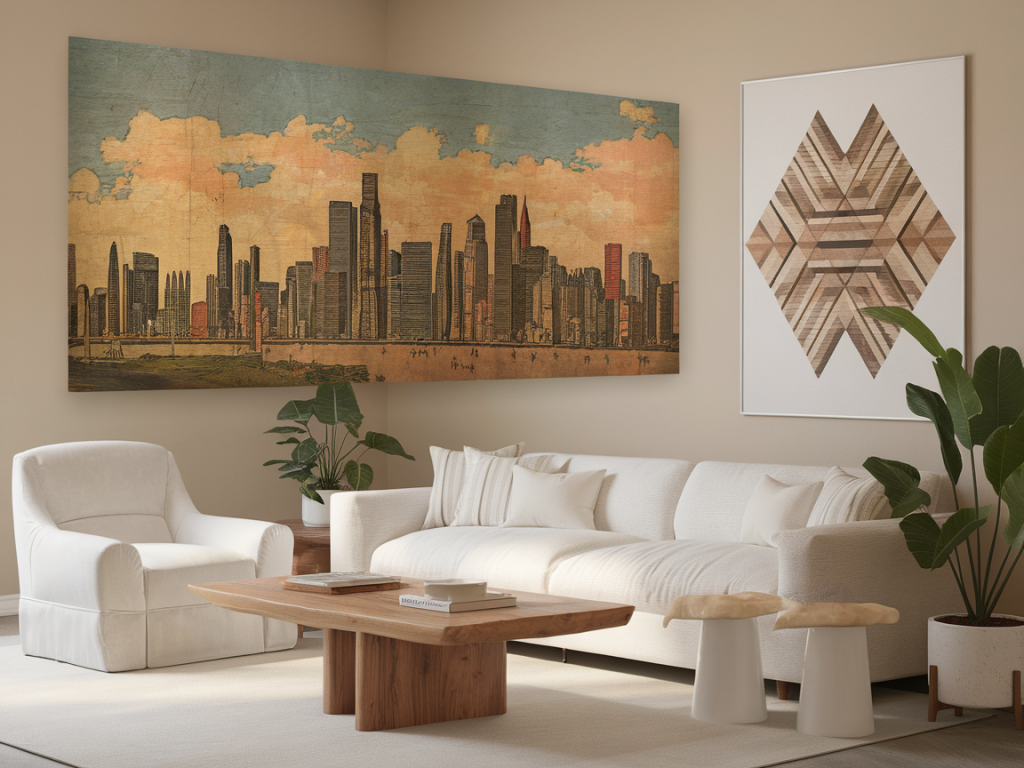
Mixing vintage wall art with modern prints is one of my favorite ways to give a room personality. When done well, the contrast between patina and precision creates depth, surprise and a lived-in elegance that feels intentional rather than cluttered. Over the years curating pieces for Thukthaeshop, I’ve learned a few simple rules and playful tricks that help these two worlds coexist beautifully — and I’m sharing them here so you can try them at home.
Start with a clear anchor
Before you hunt for that perfect vintage botanical or limited-edition modern print, pick an anchor — a focal point that sets the tone. For me, the anchor can be:
- a large vintage painting above a sofa that defines scale
- a bold modern print with graphic lines that commands eye-level
- a statement frame — an oversized gilt or deeply textured wooden frame that grounds the grouping
Once an anchor is chosen, the rest of the pieces can play supporting roles. The anchor doesn’t always have to be the biggest item; sometimes a unique frame or striking subject does the job.
Use color to build conversation
Color is the easiest bridge between eras. I often pull a single color or tone from the vintage piece and repeat it in one or two modern prints. This creates a visual thread that reads as deliberate.
Here’s a quick palette table I use when planning mixes:
| Vintage mood | Modern complements |
| Warm ochres, mustard | Matte black frame, minimalist line art in warm ink |
| Faded teals and sea greens | Abstract modern print with teal accents or brass hardware |
| Muted mauves and rose | Contemporary photographic print in soft contrast |
Repeating a hue — even subtly — ties the collection together. If your vintage piece has a small detail in a particular color, consider a modern print where that color appears as a streak or background wash.
Mix frames intentionally
Frames are the unsung heroes of eclectic walls. I like mixing styles, but with intention:
- Keep one common element — same frame finish, similar mat sizes, or a uniform frame depth.
- Pair an ornate gilt frame with a simple black or white modern frame to create contrast without chaos.
- Consider floating frames for prints and a solid, traditional frame for vintage pieces — the float makes modern works feel airy while the vintage piece holds visual weight.
A quick trick: spray-paint smaller frames in a matching tone (matte black or warm gold) so they read as part of a set even if the styles differ.
Respect scale and breathing room
One of the most common mistakes is cramming too many pieces in a small space. I always measure and mock-up layouts before hanging. If the vintage work is large and visually heavy, balance it with one or two smaller modern prints rather than several mid-sized pieces.
- Leave negative space — eyes need places to rest.
- Maintain consistent spacing between frames (I usually go for 5–8 cm depending on wall size).
- When grouping asymmetrically, anchor the layout with one central line (top, middle or bottom) so the overall silhouette feels cohesive.
Play with texture and subject matter
Vintage pieces often carry texture — brushstrokes, foxing on paper, or visible aging — while modern prints can be clean and smooth. Use that to your advantage:
- Pair a textured oil portrait with a sleek typographic print for contrast.
- Combine vintage botanical lithographs with contemporary photographic still lifes for an organic-modern dialogue.
- If all pieces feel too busy together, introduce a simple linen or woven wall hanging to absorb visual energy.
Textile wall art can be a wonderful mediator between eras — it introduces tactility without competing visually.
Use framing and matting as a unifier
Uniform matting or a consistent mat color can align vintage and modern works. I sometimes use off-white mats for everything and vary only the frames. This small, cost-effective step makes a diverse collection feel curated.
Curate through theme, not just era
When I curate walls for clients or edit the shop, I often pick a unifying theme: botanicals, travel, portraiture, or abstract geometry. Themes give permission for wide stylistic differences because the subject ties pieces together.
For example, a wall themed "Coastal Memories" could include:
- a faded 1940s seaside oil
- a contemporary map print with muted blues
- a modern monochrome photograph of waves
Even if the styles vary, the theme creates narrative cohesion.
Lighting matters
How you light the wall changes everything. Vintage works with delicate surfaces often look best with soft, warm lighting; modern prints benefit from clearer, cooler lighting that highlights crisp lines. If you can, use adjustable picture lights or wall washers that let you control warmth and direction.
Answering common questions
How do I start if I only have one vintage piece?
Start small. Place your vintage piece in a simple frame that elevates it, then introduce one modern print that picks up a color or shape from the vintage work. A small shelf with objects (a ceramic, a stack of books) can help blend the eras.
What if my vintage piece is damaged or faded?
Embrace it. Patina tells a story. If the damage is distracting, consider a conservation mat or having the piece professionally restored. Otherwise, place it among modern pieces so its age reads as character rather than neglect.
Can I mix very different subjects (landscape, abstract, portrait)?
Yes — if you find a linking device: color, frame, scale, or theme. The human eye loves contrast; your job is to make the contrasts feel intentional.
Practical hanging tips
- Mock-up with kraft paper templates taped to the wall before committing to nails.
- Hang at eye level for the main anchor (around 145–150 cm from the floor to the center works well in most rooms).
- Use picture-hanging hardware appropriate to your wall type — anchors for plaster, toggle bolts for drywall.
Mixing vintage wall art with modern prints is a conversation — between eras, makers and moments in time. When you let color, scale, framing and theme guide you, the result is a rich, layered wall that feels curated from the heart. Try one small mix first, and you’ll quickly learn what combinations sing in your space.